A Second Watch for the Film You Nearly Forgot
A second watch for a film you nearly forgot can turn one small question into a relaxed viewing plan—and make a quiet detail easier to notice.
What might you notice on a second watch of a film you nearly forgot? A second watch for a film you nearly forgot works best when you bring one small question, not a verdict to revise. Maybe you remember a red umbrella, a strange pause, or simply the feeling that a scene passed without leaving a mark. Let that fragment guide the evening.
The point is not to prove the film was secretly brilliant, or to catch every clue you missed. It is to give your attention a modest task and see what the movie does with it. Think of this as field notes for a low-pressure rewatch: one question, a few observations, and room for the film to remain forgettable if that is still your honest response.
Choose a question small enough to carry
Broad prompts such as “What is this film really about?” can turn a couch into a classroom. A focused question keeps your attention nimble. Try one that can be answered by watching rather than by searching for an explanation afterward:
- When does the main character first stop listening?
- Which object keeps appearing in scenes with a particular person?
- Does the camera stay close to the character who speaks, or to the person who reacts?
- What changes in the sound when the story moves somewhere unfamiliar?
- Does a repeated line feel different the second time it is spoken?
Pick the question that grows from what you actually remember. If a single location comes to mind, track how the film uses that space. If you recall a performer’s face but not the plot, watch for the moment their expression changes before their words do. The question should be specific enough to notice and open enough that the answer can surprise you.
Let the first impression stay in the room
Before pressing play, jot down a few plain words about the first viewing: “slow opening,” “liked the apartment,” “forgot the ending.” This is not a scorecard. It is a snapshot of what stuck, useful because the gaps in your memory may be as revealing as the details you retained.
A blank spot does not automatically mean the film failed. Perhaps you watched while tired, or the story’s people and places blurred together. Perhaps the film made its point quietly, without a scene designed to lodge in your mind. Keep these possibilities as possibilities; there is no need to diagnose your original reaction before watching again.
Say you remember a family meal but not why the scene mattered. Your question might be, “Who does the camera return to when nobody is speaking?” On the rewatch, note whether the frame favors the person holding the conversation, the one trying to escape it, or someone watching from the edge. You have a concrete thread to follow, without assuming the scene must contain a hidden revelation.
Make the room easy to watch in
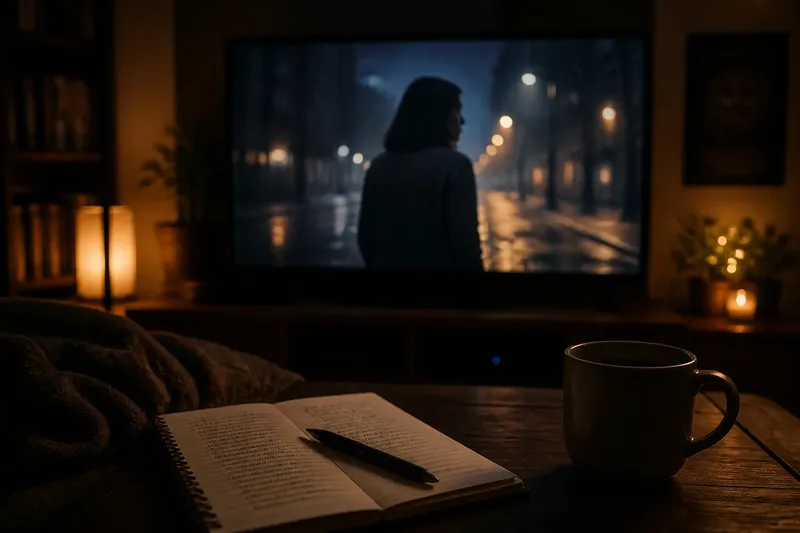
A relaxed plan is mostly about removing small distractions, not building a ritual. Choose a time when you can follow the film without repeatedly checking messages. Put a notebook or a notes app nearby if writing helps, but do not try to transcribe the screening. One or two brief observations are enough.
Leave subtitles on if they help you stay with dialogue, especially if the film is quiet or the room is noisy. If you are watching on a television, dim nearby lights enough to see the image comfortably without turning the room into a formal theater. Headphones can help with a laptop viewing, though speakers may make music and environmental sound easier to notice. Choose what suits your space.
Resist pausing at every intriguing image. The scene may gain meaning from what comes next, and constant interruption can make a gentle rewatch feel like an inspection. If a detail catches you, remember the rough point in the story or make a quick mark, then let the film continue.
Follow the film’s small signals
Once the film begins, pay attention to changes rather than collecting isolated curiosities. A doorway might matter because the character who usually enters now waits outside. A familiar sound may shift from background texture to something a character notices. A cut may leave one person’s reaction onscreen after the other has finished speaking. The value lies in the pattern, not in declaring every object a symbol.
For a film that felt slow, notice whether it is actually giving scenes more breathing room or repeating the same beat without changing it. For a plot that was hard to retain, watch how locations, clothing, or objects help mark a shift in the characters’ relationships. These observations can clarify the film’s shape without demanding a full plot reconstruction.
Pay attention to your own response, too. Did a scene become more absorbing once you knew what kind of story it was? Did you drift at the same point? A second viewing can sharpen your sense of what the film offers you, but it does not owe you a new affection. Some movies remain distant, and that is a useful observation rather than a viewing failure.
Keep notes that preserve uncertainty
Good rewatch notes are short and concrete. Write “the hallway gets quieter after the call,” not “the hallway represents isolation,” unless the film gives you a clear reason to make that larger claim. The first note records something observable; the second risks closing down the question too soon.
Try a simple three-part note after a scene that catches your attention:
- What happened: describe the visible or audible change.
- What I wondered: connect it to your viewing question.
- What happened later: record whether the film returned to it or moved elsewhere.
This keeps interpretation attached to the movie’s actual choices. If you notice a song returning, for instance, write down where it appears and what the characters are doing. You can decide afterward whether the repetitions form a pattern or simply belong to the soundtrack’s mood.
What can a second watch answer?
Should I rewatch the whole film?
If the question depends on how a detail changes over time, a full viewing is more useful than jumping between scenes. If you are mainly curious about a particular moment, revisiting that scene afterward can help, but begin with the film’s surrounding context when you can.
What if I still do not like it?
Then you have a clearer sense of why it did not work for you, or confirmation that it simply leaves you cold. A rewatch is an invitation to notice, not an obligation to upgrade your opinion.
Is it better to watch with someone else?
A companion can make small details easier to discuss, but agree to save conversation until the film ends if you want an uninterrupted watch. You can each carry a different question and compare notes afterward without trying to settle on one correct reading.
Should I read explanations before watching again?
Usually, keep outside explanations until afterward if your aim is to see what the film itself communicates. If you already know a major plot turn, choose a question about staging, sound, or performance so the rewatch still has something fresh to follow.
End with one observation, not a verdict
After the credits, return to the question you chose. Write a sentence about what you noticed, then a sentence about what remains uncertain. “The camera keeps finding the daughter at the edge of the table, but I can’t tell whether she feels excluded or prefers watching” is a more useful record than a final rating when the point was to look closely.
If the film now feels richer, let the reason be concrete: a recurring gesture, a change in the room’s sound, or a performance detail that gained weight. If it has not moved you, your brief notes can still preserve the one thing you noticed. A second watch for the film you nearly forgot need not rescue the movie; it only needs to make the next viewing question easier to ask.